
Language and Literacy in Young People
This website was created by Suze Leitao (Curtin University) in 2017. You will find a wealth of high-quality information on this website with free access to several assessments and intervention programs. For example:
- ONIP: This is a freely available oral narrative intervention programme delivered in a book sharing context. You will have access to the manual with links to the literature and theory, and 18 session plans. It was designed, developed and evaluated by Laura Glisson in her MPhil research.
- Oral Inferential Comprehension Intervention program. This is a freely available 16 session small group intervention programme targeting oral inferential comprehension of narratives. It was evaluated in a randomised controlled trial with young children with developmental language disorder (published in 2019 by Dawes et al., doi:10.1177/0265659018815736).
- Peter and the Cat Narrative Comprehension Assessment.
Building Early Sentences Therapy (BEST)
Building Early Sentences Therapy (BEST) is a specialist early years intervention developed by Dr Cristina McKean, Dr Sean Pert and Dr Carol Stow. BEST is designed for children with severe language difficulties, delivered by speech and language therapists (SLTs), speech and language therapy assistants (SLTAs) or education professionals supported by an SLT. This website provides all of the BEST resources and support for using BEST - How good is that! For links to publications involving BEST - visit this site.
Sarah Spencer, SLT
Sarah Spencer is a lecturer and speech and language therapist at the department for Human Communication Sciences, University of Sheffield, UK. On Sarah's website you will find more information about an intervention programme aimed at improving adolescent knowledge of cross-curriculum words. It provides access to the program itself, including lesson plans and an evaluation. The results from this study have been have been published:
Spencer, S., Clegg, J., Lowe, H., & Stackhouse, J. (2017). Increasing adolescents' depth of understanding of cross-curriculum words: an intervention study. International Journal of Language & Communication Disorders, 52(5):652-668, doi: 10.1111/1460-6984.12309
Rice Wexler Test of Early Grammatical Impairment
The full manual and all accompanying materials are available from Prof Mabel Rice's website. Standardization of the TEGI was took place in 2000. The instrument was standardized with 393 children between the ages of 3.00 and 6.11, whose language skills were considered to be developing normally, and 444 children between the ages of 3.00 and 8.11 who had a diagnosed language disorder. The test's psychometric properties are described in the manual. Note that the test is standardized on children from the US, so it is not clear if these results generalize to Australian / NZ children.

Multilingualism - Flyer series
The Berlin Interdisciplinary Network for Multilingualism (BIVEM) created a flyer series to inform educational professionals, parents of multilingual children and others interested in this topic.
The free-to-download flyers are available in several languages and cover a range of topics, such as "speaking your home language/s with your children"; "achieving bilingualism for children with language impairment", and "staying mulilingual".
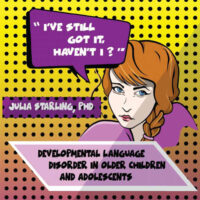
Links Resources - Linking Language with Middle and Upper Primary School Learning
Julia Starling is a Sydney-based speech-language pathologist who has extensive experience developing and implementing interventions for supporting young people with Developmental Language Disorder/Language Disorder. Julia maintains a private caseload of mainly upper primary and secondary students, is implementing the LINK-S Program in schools across Australia, regularly lectures and presents seminars and workshops, and has an active involvement in research projects.
This website contains some great evidence-based resources for speech pathologists working in schools. Although most of the programs need to be purchased, the booklet: DLD in older children and adolescents is free and contains some great tips.